
Antigua and Barbuda may suspend its citizenship programme by 12 November: what applicants already in the pipeline should do
- 14 November 2026
- Posted by: Shirish Agarwal
- Category: Antigua & Barbuda
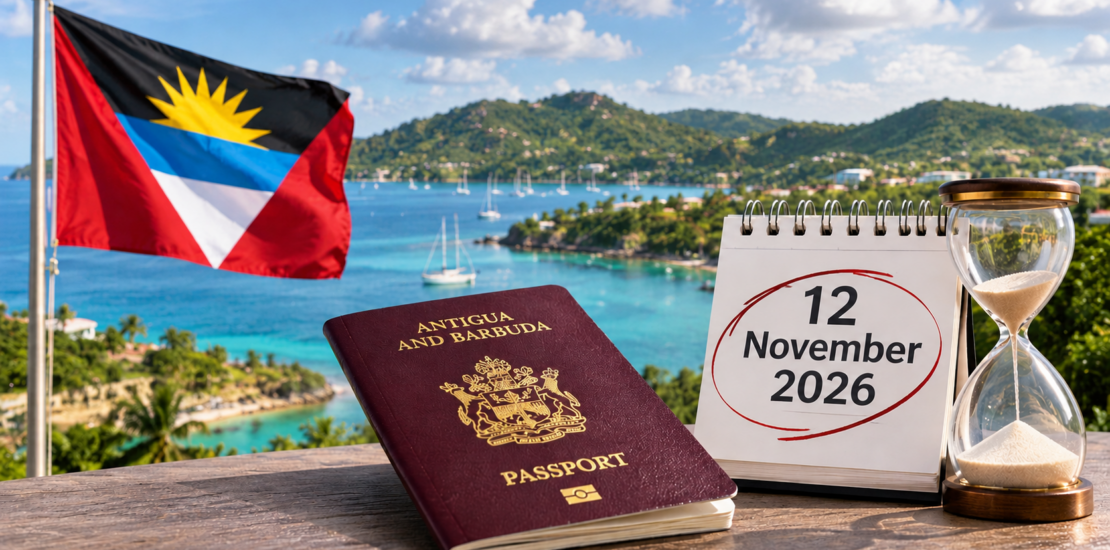
Antigua and Barbuda has until 12 November 2026 to give the European Commission its answer on whether it will close its citizenship by investment programme. Prime Minister Gaston Browne said on 24 October that the Cabinet was leaning towards suspension, but nothing has been finalised. On 30 October he wrote to Brussels offering to end the programme by the end of 2030 if the EU agrees to a longer transition. No agreement has been reported, and there is no published decision on files already in progress.
If you have an application in the pipeline, the sensible response is to find out exactly where your file stands, get that in writing and keep your options open. This guide sets out what is known, what is not and what to do next. It forms part of our wider guidance on citizenship by investment programmes, where timing can matter as much as price.
What has been announced so far?
The pressure comes from the EU. In a letter dated 25 June 2026, European Commissioner Magnus Brunner asked Antigua and Barbuda to phase out its programme by 1 June 2028. According to the Canada Caribbean Institute’s report on the EU letter, the request rests on a revised visa suspension mechanism adopted on 31 December 2025. Under it, the operation of a citizenship by investment scheme can itself justify suspending visa-free access to the Schengen area.
Browne has said the Cabinet’s preliminary view favoured confirming the phase-out, with a final decision still to come. His 30 October letter then went further, offering to close by the end of 2030 on conditions. Those include an EU-backed transition, financial and technical support, and an impact assessment reporting to the Commission by March 2027.
|
Date |
Development |
|
25 June 2026 |
EU Commissioner asks for the programme to end by 1 June 2028 |
|
24 October 2026 |
Browne says the Cabinet is leaning towards suspension, with no final decision |
|
30 October 2026 |
Letter to Brussels offers closure by the end of 2030 if the EU agrees to a longer transition |
|
12 November 2026 |
Deadline to tell the Commission the government’s decision |
|
December 2026 |
Commission expected to reflect responses in its visa suspension mechanism report |
|
January 2027 |
Possible EU announcement on visa-free access if there is no agreement, with any restrictions around March or April |
Industry coverage, including IMI Daily’s report on the 12 November deadline, describes the position as fluid. Treat any firm claim about a closing date for new applications with caution until the government publishes it.
Will the programme close on 12 November?
Not necessarily, and nobody outside the government can say for certain. The 12 November date is a deadline for a response to the EU, not a published closing date for the programme. The letter of 30 October points to a longer wind-down, though a suspension of new applications could still be announced at short notice.
That distinction matters. A phase-out running to 2030 and a suspension that stops intake within weeks are very different situations for someone with a file half-way through. Until the government publishes the rules, you can only plan for both.
What happens to applications already in progress?
This is the question most applicants are asking, and it has no official answer yet. No government decision on pending files has been reported, and advisers in the industry have been asking for clarity. How a file is treated could well depend on how far along it is, so the stage of your application is likely to matter.
The stages worth identifying are the ones below.
- Application Submitted And Fees Paid
- Due Diligence Under Way
- Approval In Principle Received
- Investment Contribution Paid Or Property Purchased
- Citizenship Certificate Issued
- Passport Application Submitted
If you are towards the end of that list, you are likely in a stronger position than someone who has only lodged paperwork. Even so, it is not guaranteed, and you should avoid assuming that earlier payments protect you.
What to do if you already have an application in the pipeline
Start by getting facts, not reassurance. Ask your agent or your lawyer to confirm in writing which stage your file has reached, what has been paid and to whom, and what the government has said about files in progress. Keep a dated record of every document and receipt.
Then think carefully before you send more money. If you are about to pay the main contribution or complete a property purchase, ask what protection you have if the programme closes before your citizenship is granted. A refund route, if one exists, should be set out in writing before the payment, not after.
Where a real estate purchase is part of the plan, the property carries its own risks if the citizenship route stalls. Our real estate services for overseas investors can help you think through that exposure before you commit funds.
Does a suspension affect people who already hold citizenship?
No, not automatically. An EU decision on visa-free access would affect short stays in the Schengen area, not the citizenship itself. Reporting on the revised mechanism says a suspension could last 12 months and be extended by 24 months, and that affected travellers could still apply for a Schengen visa. Existing citizens would keep their passports.
For a UK-based family, the practical effect would be on travel convenience for the Antiguan passport, not on UK rights or status. The cost of a visa application and the extra planning is a real consideration if you chose Antigua mainly for easy European travel.
Is this only an Antigua issue?
No. Reuters reported on 29 October that the EU set the same 12 November deadline for Antigua and four other Eastern Caribbean countries, and Browne has been seeking a joint regional response. If you were thinking of switching from Antigua to another programme in the same group, check that programme’s position carefully, because it faces similar pressure.
Programmes outside that group, such as Türkiye or Malta, work to different rules and timelines. We explain how they compare in our residency and citizenship by investment section. A second citizenship decision made in a hurry tends to cost more than one made with time to compare.
A worked example
Imagine you applied in the summer and have just received approval in principle. The reported minimum contribution is about US200,000, which at the 27 October rate of US1.33 to £1 is roughly £150,000. You are about to pay it, and your agent says to hurry before any announcement.
A calm way to handle that is to ask three questions in writing. What exactly does the government say will happen to approved files? What happens to the payment if the programme closes before citizenship is granted? And is there a refund route and who administers it? If the answers are vague, treat that as a warning. A short delay while you get clarity usually costs less than a payment you cannot recover.
Frequently asked questions
Is Antigua and Barbuda suspending its citizenship by investment programme?
Not yet confirmed. The Cabinet has leaned towards suspension, and on 30 October the Prime Minister offered the EU a closure by the end of 2030 on conditions. A final response is due by 12 November 2026.
What happens to my pending application?
No official position on pending files has been published. Ask your agent to confirm your stage in writing and to tell you what protection applies if the programme closes.
Can I still apply to the Antigua programme now?
The programme has not been formally closed to new applicants at the time of writing. A new application is a higher risk than usual, so check the latest official position before you pay anything.
Will I lose my citizenship if the programme closes?
No. A programme closure or an EU visa decision does not remove citizenship already granted. It may affect where you can travel without a visa.
Why is the EU asking Antigua to close the programme?
The EU argues that such programmes can let people with few ties to a country obtain citizenship and visa-free access to the Schengen area, which raises security concerns. Its revised mechanism allows visa-free access to be suspended on that basis.
Get clear advice before you pay anything further
Where a programme is changing, the order in which you do things matters. If you have a file in progress, or you are weighing Antigua against other options, our team can guide you through our citizenship and residency migration services. If a move would also involve your children’s education, our global education services can help you plan that alongside. Get in touch and we will help you decide the next step.

Moving Borders... Building Futures...
Contact with our legal experts and take the first step toward seamless international relocation.
Ready to secure your future with global opportunities?
Let our experts guide you through the best Golden Visa and Citizenship by Investment programmes.